Doan Trust Dem Buckra
Why my Congo spirits ask "somo o no somo?"

Hey Family,
The Gullah Geechee phrase has been ringing in my ears for weeks now, getting louder with each passing day. “Doan trust dem buckra.” Don’t trust those white people. It is a warning passed down through generations, a code of survival whispered in kitchens and carried across oceans. And lately, I cannot stop thinking about what it means to have been protected from the full force of whiteness throughout my life, even if none of us emerge entirely unscathed. Because whiteness is not just a social construct. It is standard malware, pre-installed into every facet of American life, and it is inherently dangerous to Blackness. It is inherently malicious and deadly.
I have been thinking about my previous essay, “I Love Black Children, but I’m Terrified for Them,” and how the terror I described then has only crystallized into something sharper, more urgent. We are watching lynchings rise across America. Black bodies are being found hanging from trees, and with alarming frequency, these deaths are being ruled suicides with no foul play. The official narrative strains credulity, yet it persists, bolstered by a system designed to protect itself rather than the truth. How many times must we scream into the void before someone listens?
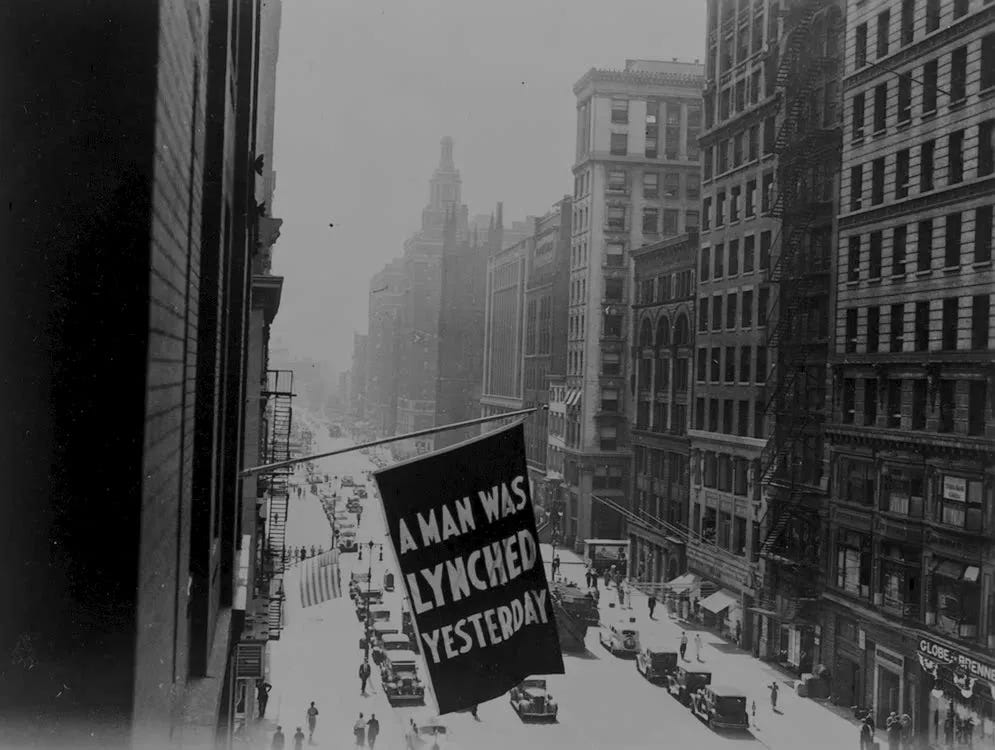
Consider the recent cases. In May 2026, Juliana Nzita, a 16-year-old girl, was found hanging from a tree in Charlotte, North Carolina. The Charlotte-Mecklenburg Police Department ruled her death a suicide, yet community members and civil rights advocates highlighted unanswered questions that refuse to be ignored. In June 2026, To’nea Miller, a 27-year-old woman, was found near Gwen Cherry Park in Miami, Florida. The lack of initial coverage and the public location of her body sparked significant outcry and demands for answers. In February 2026, Kyle Bassinga, a 21-year-old man, was discovered in a park in Cobb County, Georgia. Authorities ruled the death a suicide with no foul play suspected, but local officials acknowledged the triggering nature of the discovery due to the historical context of the area. These are not isolated incidents. They are a pattern, a resurgence of a terror we were told was behind us.
And we live in a surveillance state. We have flock cameras on every corner, Ring cameras on every porch, our texts being read by the phone company, the Cloud keeping every photo with the metadata to match. We have cell phone towers and satellites, more data than humanly possible. And somehow, we have more plausible deniability than ever. If we can track a stolen car across state lines in minutes, if we can identify faces in a crowd from space, how is it that these deaths remain so opaque? The technology exists to provide answers, yet the system refuses to use it. Or perhaps it does use it, just not for us. The surveillance is not for our protection. It is for our containment.
This is not new. We have been here before. Ida B. Wells-Barnett, a native of Holly Springs, Mississippi, understood this intimately. Born into slavery in 1862, Wells became a journalist and co-owner of the Memphis Free Speech, using her pen to expose the horrors of lynching. After the lynching of three Black grocery store owners in Memphis, men whose only crime was competing with white businesses, Wells wrote a searing editorial that questioned the legitimacy of a justice system built on discrimination and accused the entire white community of complicity. The backlash was swift and violent. In 1892, she was forced to flee Memphis and the South entirely, her newspaper’s press burned, her life threatened. A young woman from Mississippi, she was driven from her home because she was bringing too much attention to the institution of lynching in America.

Her work, including pamphlets like Southern Horrors and A Red Record, meticulously documented the truth: lynchings were not about protecting white womanhood, as was so often claimed, but about racial terror, economic competition, and maintaining white supremacy. She gathered statistics, named names, and forced the world to look at the barbarism of American racism. And for her trouble, she was exiled. The cost of telling the truth about whiteness was her home.
It would take nearly 130 years for the federal government to finally, formally, outlaw lynching. The Emmett Till Antilynching Act was signed into law in 2022. One hundred and thirty years. Let that sink in. Emmett Till, the 14-year-old boy from Chicago whose brutal murder in Mississippi in 1955 galvanized the Civil Rights Movement, has his name on the bill. But it took over 200 failed attempts, a century of legislative inaction, to make it happen. The delay is not just a stain; it is a testament to the deep-seated, normalized nature of the racism Shirley Chisholm spoke of. As she wrote in her memoirs: “Racism is so universal in this country, so widespread, and deep-seated, that it is invisible because it is so normal.” It is the water we swim in, and we have been conditioned not to see it.
Historically, the KKK wore hoods because they were people who did not want to be known for their hateful ideology. They just wanted to benefit from it. They were the police, the judges, the lawyers, the business owners, the mailman. Any and everybody. The hood allowed them to terrorize with impunity, to act without consequence, to maintain the fiction that they were upstanding citizens by day and monsters by night. The mask was a permission slip, a way to separate the public face of respectability from the private face of terror.
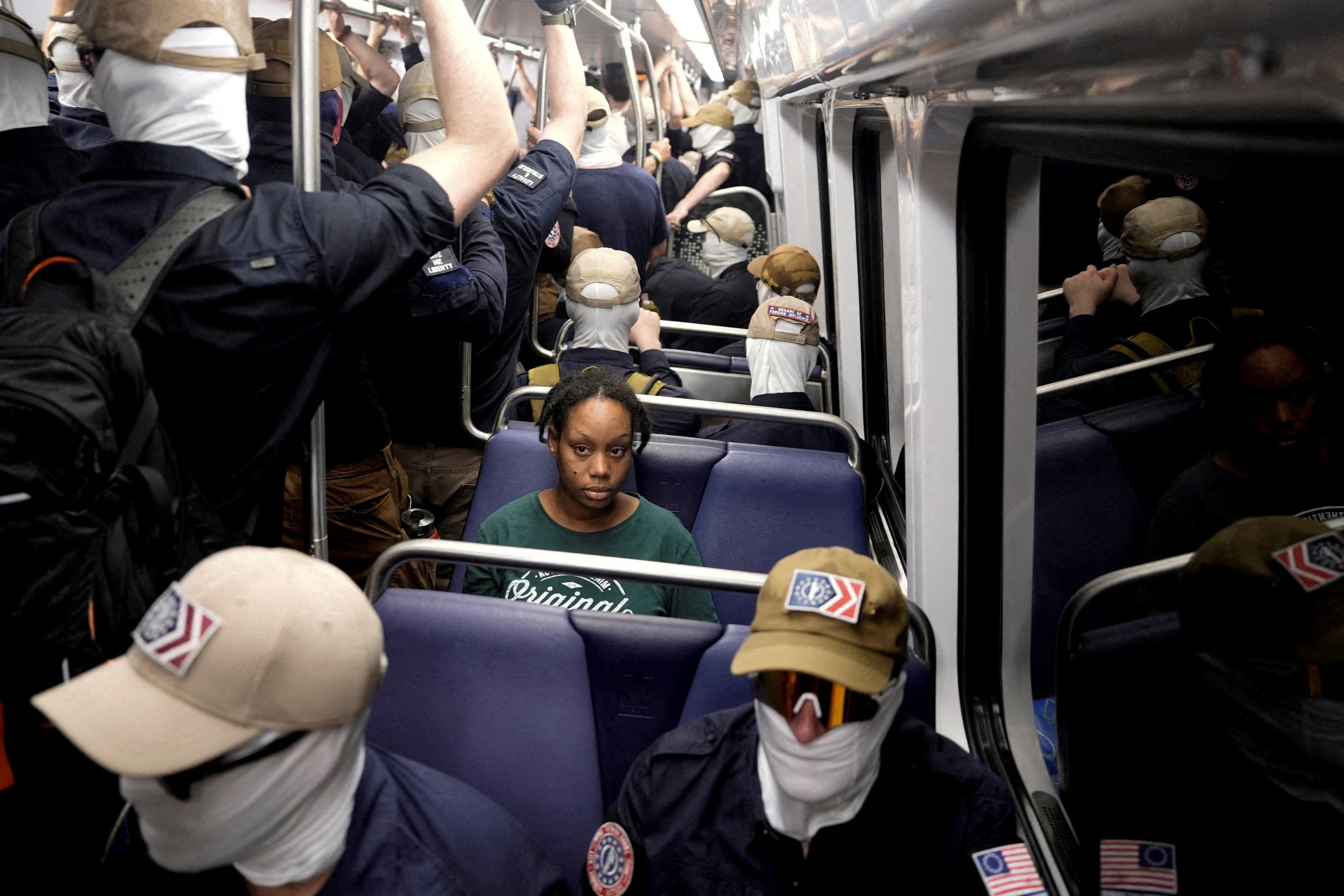
Now consider the Patriot Front march on Washington, D.C., on July 4, 2026. Hundreds of masked men, carrying banners including the Confederate flag, marched through the nation’s capital on the 250th anniversary of the United States’ inception. They gathered in front of Union Station and marched toward Capitol Hill, chanting “Life, liberty, victory!” and “Reclaim America!” Their founder, Thomas Rousseau, led the neo-fascist, white supremacist organization through the streets, their white masks hiding their faces as they demanded to take their country back. They rode the D.C. Metro, other riders looking on warily, the banality of their evil on full display. Yet when asked about white nationalists marching in Washington, the U.S. Secretary of the Interior, Doug Burgum, told CNN that “what they stand for is nothing … I could agree with – but one of the foundational principles of the United States which makes democracy messy is free speech.” Free speech. For masked men waving Confederate flags, chanting for a white ethnostate. Free speech, while Black bodies hang from trees and are ruled suicides.
The masks are different now, white, tactical, modern, but the intent is the same. The hoods have simply been rebranded. Patriot Front, founded in 2017 after the deadly Unite the Right rally in Charlottesville, has gained visibility over the years as those connected to white supremacist organizations have been widely embraced by the current administration. An expert on extremist groups told the Guardian in 2022 that Patriot Front’s fundraising and mobilizing efforts resembled those of a media production company: “No other white supremacist group operating in the US today can match Patriot Front’s ability to produce media, ability to mobilize across the country and ability to finance.” They are not a fringe group. They are a well-funded, highly organized operation, and they are marching in our capital, masked and unashamed.
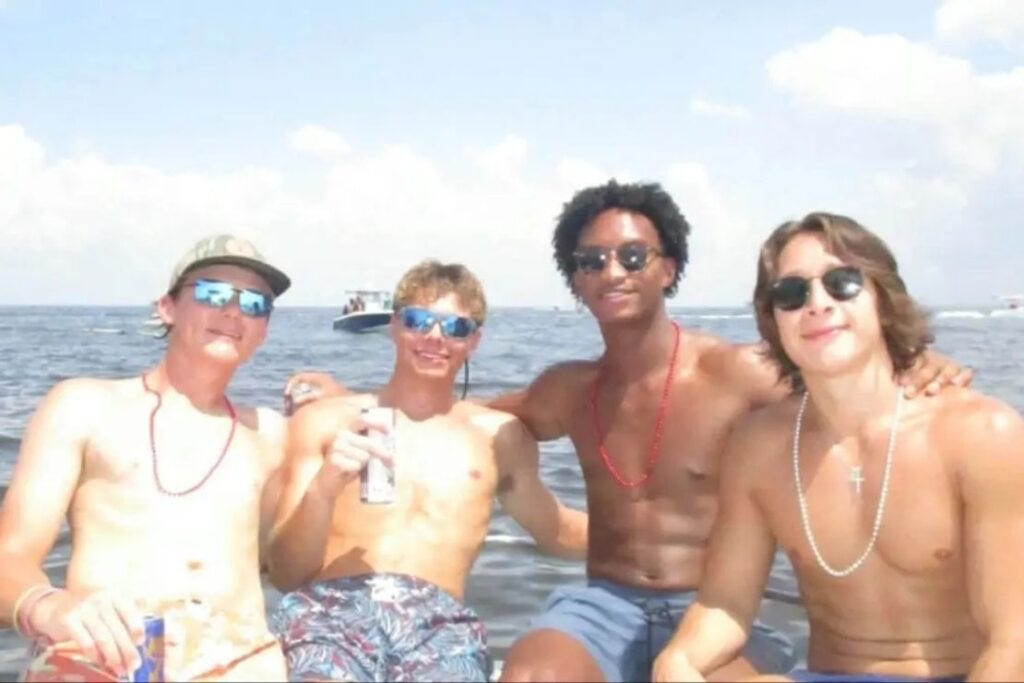
This brings me to the recent, horrifying case of Nolan Wells. The 18-year-old college football player, the only Black kid on a boat trip to Horn Island, Mississippi, over the Fourth of July holiday, is dead. His body was found in the water, and authorities have ruled there was “no foul play suspected.” He was a swimmer. His cell phone and car keys were brought back to shore by his friends without him. The Jackson County Sheriff’s Office claims Wells may have “chose to stay on the island with the assumption that he was going to ride back to the mainland with someone else.” But as his mother, Christine Wonsley, said, that simply was not in his character. His family has hired civil rights attorney Ben Crump to conduct an independent investigation, and the Rev. Al Sharpton is officiating his funeral, with support from Tyler Perry and Colin Kaepernick, who paid for Wells’ body to be flown to D.C. for an independent autopsy.
What are the odds that another lynching, another suspicious death of a young Black man in Mississippi, would carry the surname of the late, great Ida B. Wells? Nolan Wells. Ida B. Wells. The same state. The same injustice. The same official dismissal. It feels poetic, but not in a way that brings comfort. It feels like a haunting, a reminder that the more things change, the more they stay the same. It is a cruel echo across centuries, a testament to the enduring grip of what I have come to recognize as the cult of whiteness.
Mr. Nancy’s monologue in American Gods has been stuck in my head, too. “Slavery is a cult that rebranded, the alt-right. Every thirty seconds, a refugee girl with melanin in her skin is taken... Oppressors have created a direct path from schools to prisons for children. Even those who make it to the NFL are denied the right to protest... conditioned from birth with poor food choices, polluted water, gun violence, police brutality, and repeated trauma leading to PTSD, without therapy, leaving them alone and vulnerable.” This is the architecture of the cult. It is a system that does not just harm Black bodies; it conditions them from birth for failure, for suffering, for death. It is a violence so systemic, so woven into the fabric of our society, that it becomes invisible.
I recently read Cebo Campbell’s novel Sky Full of Elephants. The premise was intriguing: all the white people in the world get up and walk into the nearest body of water. I wanted to like it. I desperately wanted to connect with a story that imagines a world without the cult of whiteness. But the execution fell flat for me. The two main characters, a Black man who spent most of his adulthood incarcerated for sleeping with a white woman and his biracial daughter who was the result of that brief affair, were painfully anti-Black and self-loathing. I found it difficult to connect with characters who seemed so thoroughly socialized by whiteness, so disconnected from the love of their own Blackness. As someone who was not socialized around whiteness and white people until I went to college, I felt the chasm. Their internalized oppression was a mirror reflecting a world I had been, in many ways, protected from. But even protected, I am not untouched.
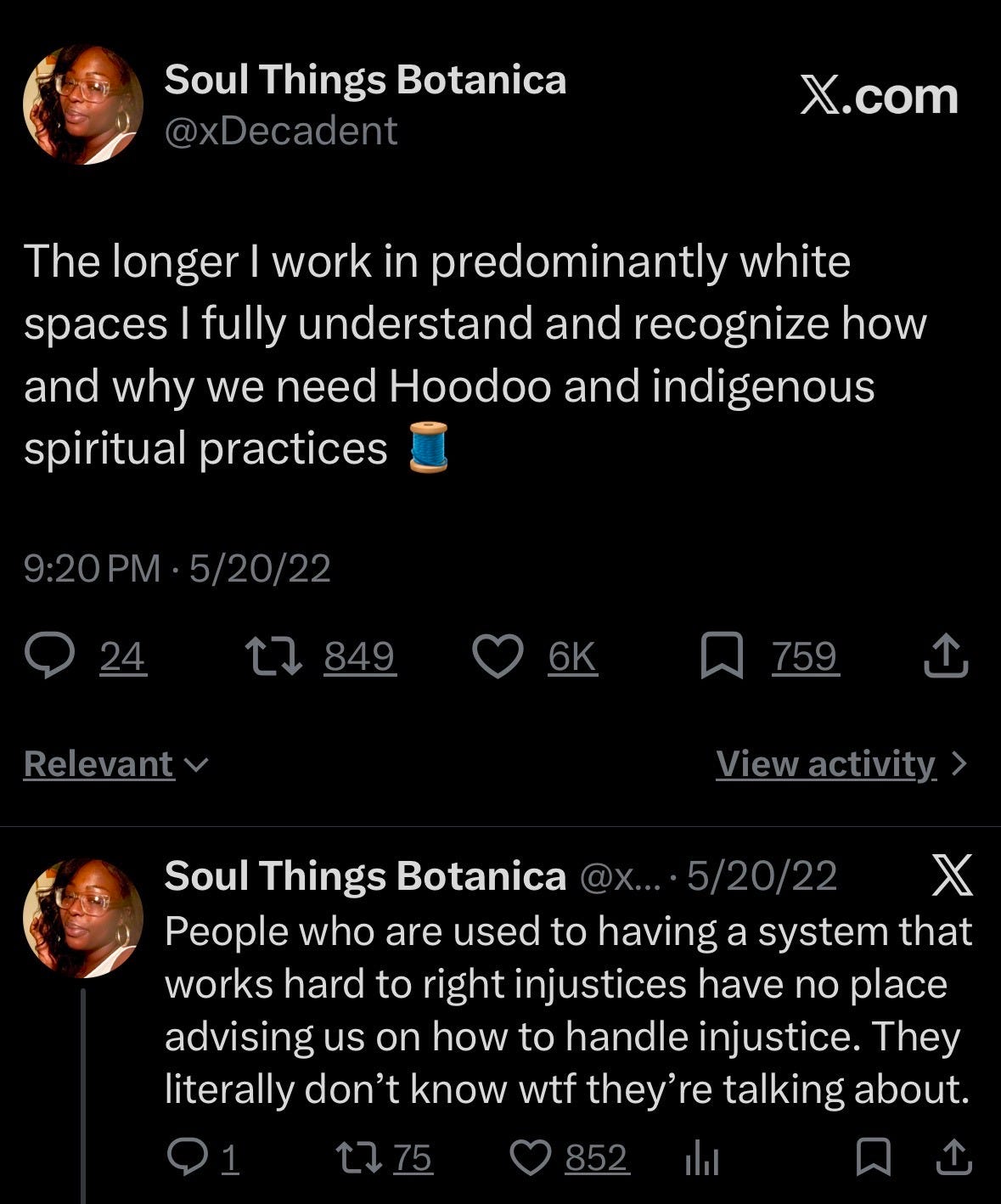
In recent TikTok videos, I spoke about a Twitter thread I did years ago where I said that the longer I worked in predominantly white spaces, the more I understood the need for hoodoo, rootwork, and our indigenous spiritual practices. I talked about a time back in 2020, when a right-wing Republican coworker tried to bait my other coworkers and me into an argument about Trump, claiming Trump “wasn’t a racist” and “wasn’t a bad guy.” When we did not take the bait, he began sharpening his knife for hours on end while playing Kentucky bluegrass at obnoxious levels. He was obviously upset that he could not harvest our fear and ire by getting argumentative about Trump, but when that did not work, he went the old-fashioned route. Someone sharpening their knife while seething with hostility is wild to experience, but racism and racial terror are not logical, and there is no way to outsmart bigotry.
My godparent gave me some instructions on how to prepare a special item to carry on my person for protection. I understand why I have very hot Congo spirits who come down and instantly ask, “somo o no somo?” I understand why they have intense distrust for white people and why they do not trust them now. I understand why Geechee Gullah culture has been so preserved, because they were isolated. I understand why the maroons in Jamaica became the maroons. Blackness is not safe in the company of whiteness. It does not move in reverse, though. They can move into our neighborhoods, and now it is gentrification, and the property values go up. We have always had to know whiteness as intimately as we know ourselves because our lives depended on it.
Some of our elders had a healthy mistrust of whiteness and white people that could look like bigotry from the outside. But upon further inspection, it was just being cautious. Given our extensive history, given the lynchings, the false suicides, the century of legislative inaction, the haunting echo of Nolan Wells, the masked marchers in our capital, who can blame anyone for saying “doan trust dem buckra”? It is not hate. It is survival. It is a recognition that whiteness, as a system, as a cult, is a force that is inherently malicious and deadly to Blackness. It is a wisdom passed down through the generations, a whispered warning to protect ourselves from the malware. Because even when we think we have escaped it, it is still there, running in the background, ready to crash the system.
Doan trust dem buckra. I am starting to understand that the ringing in my ears is not just paranoia. It is a truth I can no longer afford to ignore. In a surveillance state where everything is watched except the truth, where masks have been replaced, but the faces behind them remain the same, where young Black people are found hanging from trees and it is called suicide, where the law took 130 years to catch up to a century of terror, we have to trust our elders. We have to trust the whisper. Doan trust dem buckra. It is not bigotry. It is history. And history has a way of repeating itself, especially when we refuse to learn from it.
I currently have some apparel and merch for sale on my website. If you would like to support me and my work, head over to soulthingsbotanica.com and check it out.